Since first exhibiting Emily Faludy's artwork at the start of 2025, the reception to her work has been one of both wonder and affection. The scale of the paintings and their thick impasto strokes make the artworks immediately impactful, while the subjects — often still lifes — are tender in their familiarity. However, Faludy's artwork is anything but routine: the intention behind her textured palette application signals the paintings immediately as originals, and in the current stream of reproductions and digital images, Faludy's work understands that the materiality of an artwork is perhaps more significant than ever.
To discover more about the influence of Emily Faludy's artwork, we interviewed the artist herself, covering en plein air, the history of the still life, and the power of slow looking...
Firstly, congratulations on your recent achievement of gaining funding from the Arts Council England’s ‘Develop Your Creative Practice’! How did the grant allow you to expand your work?
EF: Thank you! The DYCP funding has had a big and continuing impact on my practice; it has allowed me to work at a larger scale, both outside and in the studio. I used the time to create a series of ten 100 x 120cm paintings of the flower fields on Hayling Island, and of still life arrangements made from these same flowers. The farm there is famous for its sunflowers and wildflower meadows.
Working on that scale gave me a real sense of expansiveness and enabled me more freedom with paint application. It was a ‘proof of concept’ for me, and gave me the confidence to continue developing this thread of work.

Emily Faludy. Photo credit: Heather Chuter, Instagram @heatherchuter
Who are some artists you admire? And that have been formative to you and your practice?
EF: The painter George Rowlett, who sadly passed away just this year, was hugely formative to my practice. He was fearless with how he applied paint to the surface, creating works which are somewhere between paintings and sculptural objects, with a real boldness and unignorable physical presence. George was both an inspiration and a huge encouragement to me; I contacted him after he gave a talk at a painting event I attended in 2018 and we entered into a dialogue about our work. He was incredibly generous, offering insightful observations and swapping practical notes about the challenges of working with impasto at scale.
When I was at university, I was introduced to the work of Kyffin Williams. Several of his paintings hang at the Aberystwyth School of Art and his brooding, structured depictions of the Welsh landscape have stayed with me, prompting many a trip to Wales in search of similar inspiration.
I also admire many living artists. I admit to a preference for heavy paint application, definite marks, and strong forms. I loved the Anselm Kiefer/Van Gogh exhibition at the RA last year and revelled in the expansiveness and power of Keifer’s work. On Instagram I recently discovered Helmut Helmes, who makes large, intricate impasto paintings of close-up landscapes which hold something of the light of the evening gloaming.
You have been painting en plein air, in some capacity, since 2009. How has the act shaped your artwork since? And how has your practice of en plein air painting developed over the years?
EF: The first time I painted en plein air was a ‘eureka’ moment – it somehow felt more real, and worthwhile than painting from photographs in the studio. I was immediately addicted. Nothing has beaten that feeling of connection with the subject, and the authenticity that shines through in every mark.
The work I make outside has really evolved; for the first few years, I was focused on technical competence, just trying to make paintings work in terms of composition and tone. I wasn’t too discerning with subject matter; I’d paint almost everything! I was making mostly small work, using brushes, oil painting mediums and turps.
In the last few years, I’ve questioned my processes a lot more. Spending a year on the Turps Banana Correspondence Course encouraged me to really ask what I was doing and why; I started focusing in on themes that really interest me, from rough, stormy seas to flower fields.
I make fewer works now, but often larger ones, with much more time spent planning, rather than leaving things to chance. I switched to painting with palette knives and spatulas as it encourages strong, definite marks and results in works with both physical and emotional weight.
The paintings feel less like windows into a view, and more like painterly objects in their own right.
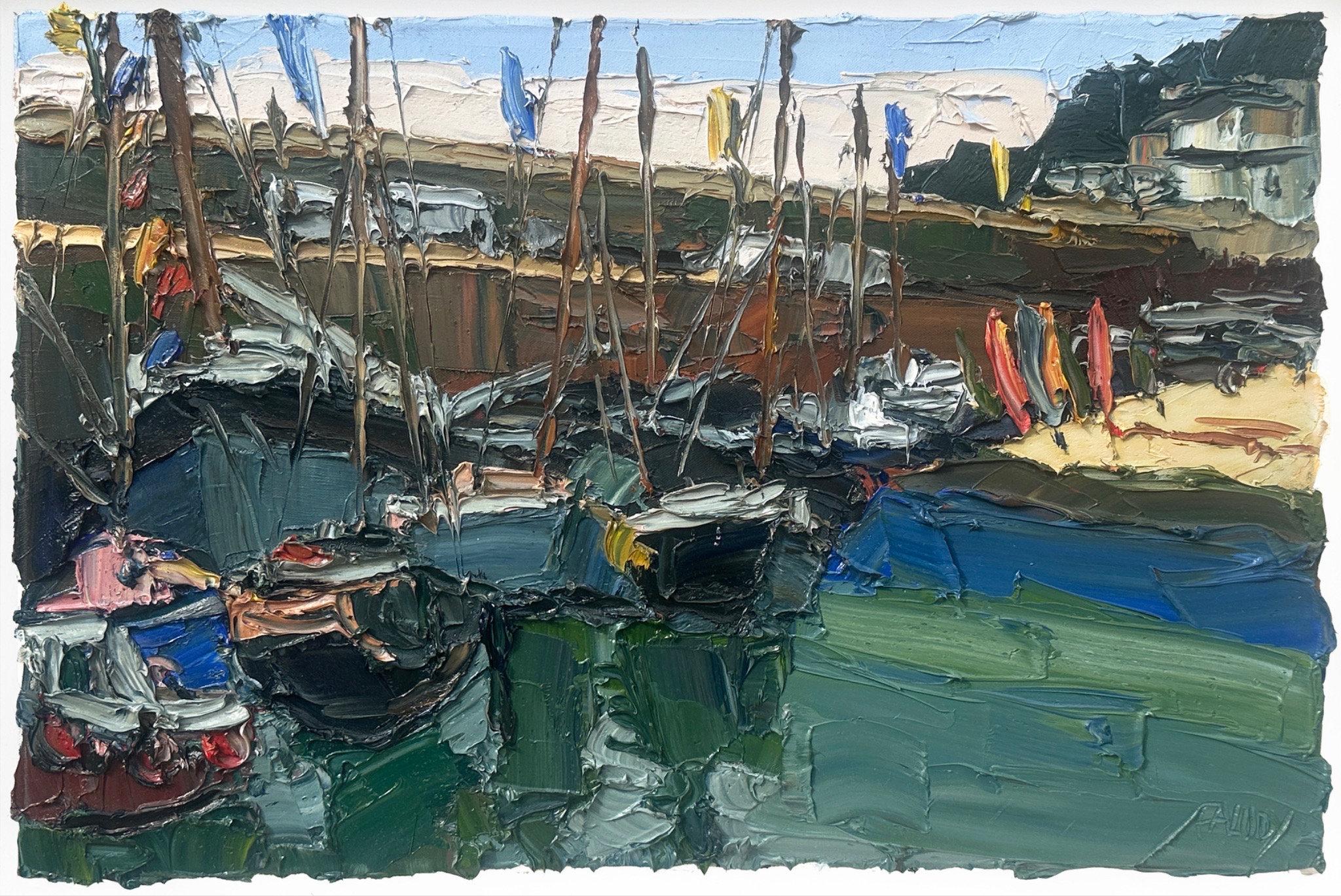
'Harbour at Mousehole - Summer, 2025' by Emily Faludy. Available to purchase here.
You paint landscapes: harbours, coastal scenes and wildflower fields, but are also distinctive for your floral arrangement still lifes. Do you feel yourself as embedded in a history of still life painters?
EF: Still lifes are a relatively new part of my work; my first one in over twenty years was a sunflower arrangement in 2024 (and by ‘arrangement’ I mean three stems bundled into a vase!)
Even though I have painted many more in the last two years, I still essentially see myself as a landscape painter who sometimes paints still lifes. Even the way I approach them is through a landscape lens; I treat the background like a sweeping sky, and the flowers as the foreground forms. When you are used to breaking a view down into composition, mass and tone, no matter what the subject is, the principles are the same.
I love the paintings of Shani Rhys James, and particularly her still lifes. You can feel the knowledge of the history of still life painting in them, in the dark backgrounds reminiscent of Dutch 17th Century paintings, but imbued with her modern, loose style and dramatic and uncompromising vision. I also love the work of Lucian Freud, who often included plants in his portraits. I like the way he painted them in just the same way as he painted everything else. As I say, it circles back to the same principles applying to everything you paint.
Do you have any thoughts on why the genre of still life painting is so enduring, still able to capture the imagination of contemporary viewers?
EF: I think the appeal in relation to floral still life painting in particular is related to our enduring relationship as humans with flowers. We imbue them with meaning and symbolism, we have built rituals around them, and beyond that, there’s just a simple appreciation of their beauty.
The cyclical nature of our own lives are reflected in their short life cycle, so making a painting is a way of pausing that process and holding on to a version of that vitality by immortalising it in paint.
On a simpler level, it’s hard not to be cheered by a large, colourful bunch of flowers! I hung one of my flower paintings up at home recently and even I was surprised by how much it enlivened the room.

'Sunflowers, Red Campion & Cornflowers, 2025' by Emily Faludy, Available to purchase here.
Roses, Sunflowers, and Lilies, flowers that are widely distributed, are the recurring subjects in your still lifes. Is there a reason you return to these subjects?
EF: I’m drawn to flowers with a strong structural shape, and roses, sunflowers and lilies all have that attribute.
Sunflowers come in so many varieties – from small and cheery, to towering, triffid-like and frankly a bit frightening. I love all the different iterations of them. Watching lilies go from tight buds to big, star-like trumpeting blooms feels most unlikely; that transformation is what keeps pulling me back to them.
Due to the thick impasto application of oil paint, your process is inherently slow - it often takes months to dry. (Much to our initial despair, as we love having your work on our walls!) But in an age defined by the attention economy and constant immediacy, I can't help but feel your work represents a kind of resistance to that. Do you see your practice as inviting the viewer to wait, and to look slowly?
EF: Yes, I think so. The paintings sit for several months before they are dry enough to frame, or even photograph properly. The impasto surface is so thick that an i phone photo won’t do it justice - I’ve had to accept this wait as part of the work’s life cycle.
What’s been useful about this is that it forces a kind of slowness. I don’t feel the pressure to post work on social media as I make it. It means I can be more considered about what to share, and when. The work isn’t a diary of my working life or the current season.
I can wait to see how a group of paintings sit together before they go out into the world. In that way I hope the work invites viewers to do the same – to wait, and look slowly.
What are you looking towards next?
EF: I am currently working on another series of (even larger!) field paintings, again funded by the Arts Council, which I’ll be exhibiting next year (2027).
I have built upon the experience I gained last year and have expanded my vision further, making work as physically big as I can, including joining the boards together to form diptychs. These are 120 x 340cm - the biggest I’ve ever worked on outside.
I want to create an immersive experience for the viewer, equivalent to being in the fields and the sensory overload that comes with that. It is testing me; the practicalities and logistics of working at this scale are hard, but I am optimistic that the results will be worth it.

