In our upcoming Autumn Exhibition, we are particularly thrilled to showcase artworks by influential 20th-century landscape painters, brothers Paul and John Nash, two artists who profoundly shaped how we visually decipher landscape in the present.
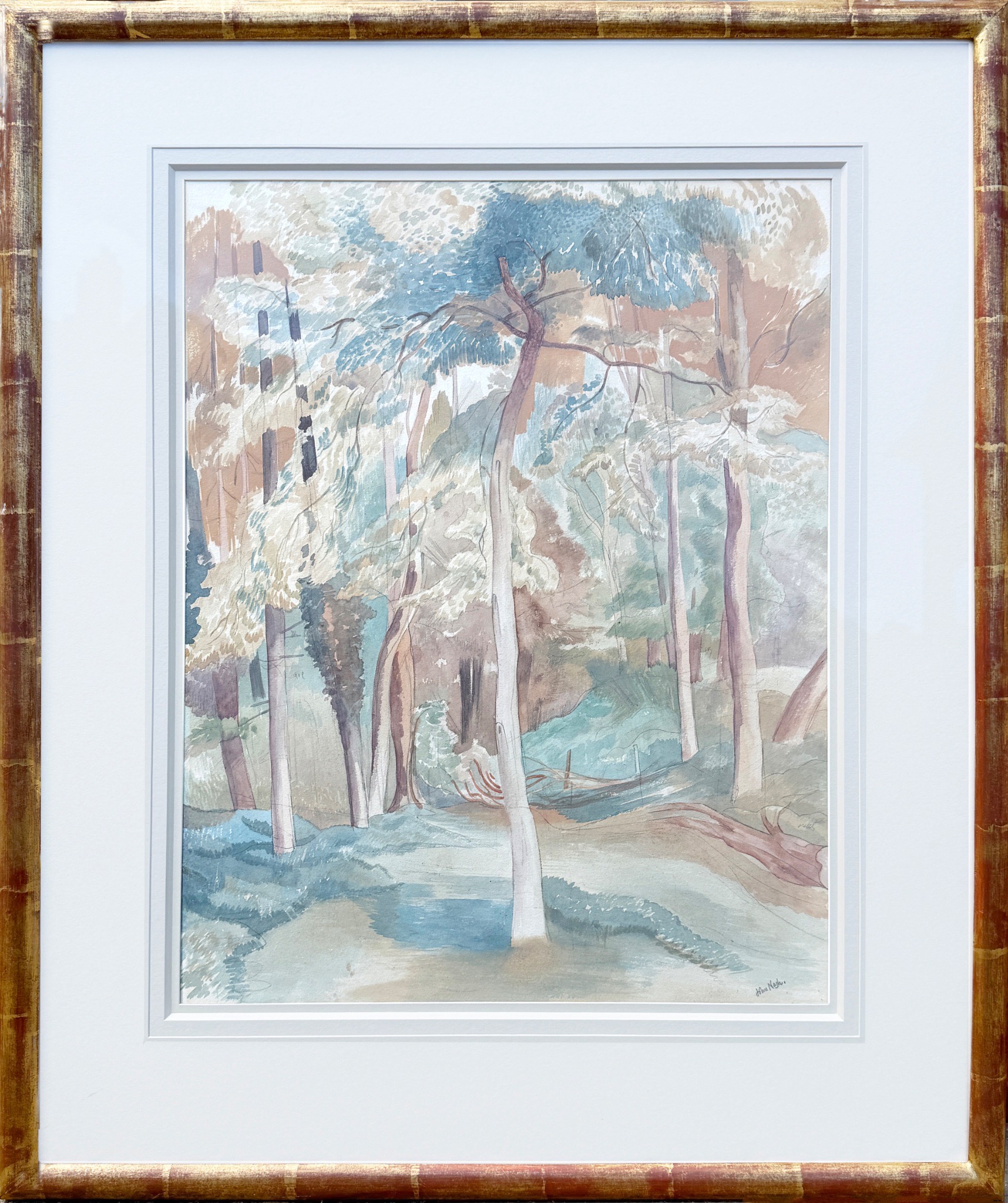
Today we are exploring The Grove by painter, wood engraver and illustrator John Nash. John, unlike his brother, had no formal art education but began producing landscape and comic drawings early on - two genres he would become renowned for later in life. It was most likely through Paul’s encouragement of John to develop these two strains as a draughtsman that led to John’s career as an artist, as Paul reminisced:
‘Watching them [his comics] closely as I did I became aware of something more than an original ‘comic’ vision which Jack [John] undoubtedly possessed. They began to show an intrinsic sense of plan and decoration. More than this the incidental features of the comic events, especially the forms of natural objects in landscape for instance, even some animals, seemed to be drawn with an intuitive understanding which made them extraordinarily convincing. I noticed these developments with growing interest. Then one day, I came upon a small sketch made on Jack’s excursion as a reporter, a little view of flooded meadows under a night sky with a hedge of trees mounting in the foreground. The moment I saw it I was convinced my brother was an artist and must be given every chance to work out whatever talent was in him.’¹
By 1912, Paul’s suspicions that John could flourish as an artist were confirmed. John had a watercolour accepted by the New English Art club, and the following year the two brothers had a joint exhibition ‘Drawings by Paul & John Nash’, at the Dorien Leigh Gallery in London, which was extremely well attended. In retrospect, Paul’s gut-instinct that the sketch of the ‘flooded meadow’ was of artistic value anticipated John's signature style, as the description tells us something of The Grove's own atmosphere years later.
The Grove is a brilliant example of what makes Nash's work distinct. It displays his deep interest in the local: as Andy Friend writes,‘his best works can be traced to locations within walking distance of his long-term homes in the Chilterns and the Stour Valley’.² More specifically, it reveals his passion for the botanical. John’s habit of looking and re-looking at his nearby environment was reported in later life as part of his philosophy, stating "the artist's main business is to train the eye to see, then to probe — and then to train his hand to work in sympathy with his eye. And what better way to train one's eye than repeated exposure."³ The Grove is thus a product of this ‘repeated exposure’.
This close observation also underpinned Nash’s success as a wood engraver. A founding member of the Society of Wood Engravers in 1920, he brought remarkable precision to the medium, producing the finely detailed prints in Poisonous Plants (1927). His passion for the minutiae apparent in botany and horticulture likewise informed his later work as an illustrator, most notably in Wild Flowers of Britain (1938) and English Garden Flowers (1948). Across these projects, Nash’s attentive study of the natural world remained at the heart of his practice.
Nash sits comfortably within the British Neo-Romantic tradition, which favoured the personal and the intuitive over pure realism. Tied to the visionaries William Blake and Samuel Palmer, the term 'Neo-Romanticism' was largely retrospective, coined by Raymond Mortimer in 1942 and defined as an "expression of an identification with nature".⁴ Where some of his fellow contemporary Neo-Romantics drew on Surrealist, Cubist and Vorticist references, Nash took a more rootless approach. It is typically cited that John Nash did not take many artistic influences, and while there is evidence to dispute this claim, it is safe to say his artwork is marked by a resistance to persuasion by artistic currents. The otherworldly energy that The Grove exudes comes partly from his dreamy, suffused colour palette, but equally from keen observation of the natural world. The anatomy of the trees is accurate, and the mysticism of the painting arises from nature itself, the hypnotic sway of the trunks and branches themselves.
Living through the looming threat and anguish of the Second World War also sharpened the Neo-Romantics’ vision of nature beyond the idealised landscapes of their artistic predecessors. As Simon Schama writes in Landscape and Memory, a landscape's “scenery is built as much from strata of memory as from layers of rock" - a merging of culture and nature that goes far beyond the purely pastoral.⁵ It is a fitting lens through which to understand Nash's work. His experience as a war artist meant he could never simply repeat artistic tradition; his psyche and the landscape, what he had seen and what he saw, were always inseparable.
¹John Nash by Sir John Rothenstein, (McDonald & Co, London: 1983), p. 11
₂ John Nash’s alluring landscapes of love and solace by Andy Friend, Art UK (3rd August 2021)
https://artuk.org/discover/stories/john-nashs-alluring-landscapes-of-love-and-solace
³ Dr Ronald Blythe (2013) The Time by the Sea: Aldeburgh 1955-1958. Chapter 5
⁴In Focus | A Brief History of Neo-Romanticism’ by Goldmark (25th July 2018)
⁵ Simon Schama, Landscape and Memory, (A.A. Knopf, New York: 1996), p.7

